Therapy for Codependency in San Francisco

If you lose track of yourself in close relationships, you may be experiencing codependency.

When their needs come first

How codependency can look

Codependency is when a person places another person’s needs consistently above their own, in a way that creates harm to themselves. It may look like:

We’re all dependent on each other to some degree, and we all need to compromise for others. That isn’t the problem, and nobody needs to become self-sufficient. What we’re after is a shift from codependency toward interdependence.

The direction of the work

Moving from codependency to interdependence

Interdependence is being able to get close to someone and still know where you end.

The work usually involves:

Relational and somatic

How I work with codependency

My approach is relational, somatic and depth-oriented. I draw on Gestalt, Hakomi and Internal Family Systems, though which of those shows up depends on what you need.

These patterns show up between us too, in the room, while they’re happening. If you notice yourself wanting to reassure me, or to make the session easier for me, that’s worth stopping on. It’s often more useful than another week of analysis, because this stuff lives in your body and your nervous system as much as it does in your thinking.

In our work, we can move toward the discomfort of naming things that feel hard to say. In having this experience, you can learn to share harder feelings in your day-to-day life.
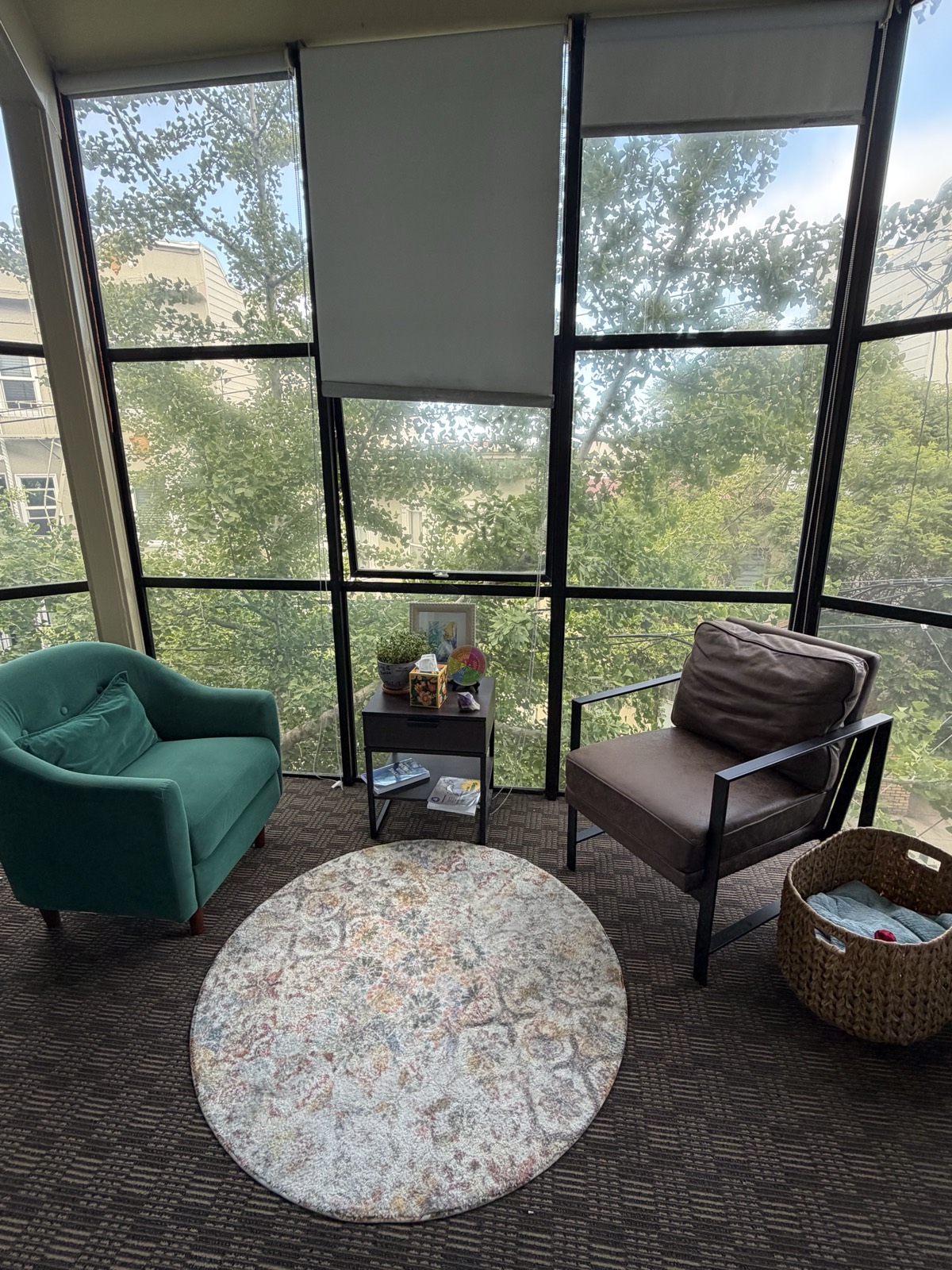

Dhespina’s therapy office

The honest answer

How do you break out of codependency?

Awareness, choice and practice. Understanding where a pattern came from doesn’t dissolve it, which is frustrating for people who’ve read a lot about this and still find themselves doing the same thing. What helps is having the awareness to choose a different experience over and over: saying the true thing, sitting with how bad that feels, and finding out the relationship survives it.

Dhespina

Hi, I’m Dhespina!

I’m an Associate Marriage and Family Therapist, and therapy with me is exploratory and collaborative, with room for reflection, humour, and unexpected moments of insight. I support you in reconnecting with the part of yourself that knows what you need and how you want to heal, even when that part feels difficult to access.

I have trained in Gestalt, Internal Family Systems, and Hakomi Therapy. My approach is relational, somatic, and trauma-informed. This means I do not see therapy as simply a place to talk, but as a space where you can experience new feelings, perspectives, and ways of relating to yourself and others.

Fees & Sliding Scale

My fee is $200 on a sliding scale down to $120. I also hold 2 low-fee slots at $60 for people facing financial difficulty from unemployment or being a student. If cost is a barrier, please ask.

Curious whether we might be a good fit?

In the first fifteen minutes, you can tell me a little about what’s bringing you to therapy now, we can get a sense of whether working together feels right, and you can ask any questions you have.

Book a free 15-minute call

Or send me a message first.